

Cruise
Cruising Galápagos with National Geographic-Lindblad Expeditions
Article and photography by Jennifer Bain
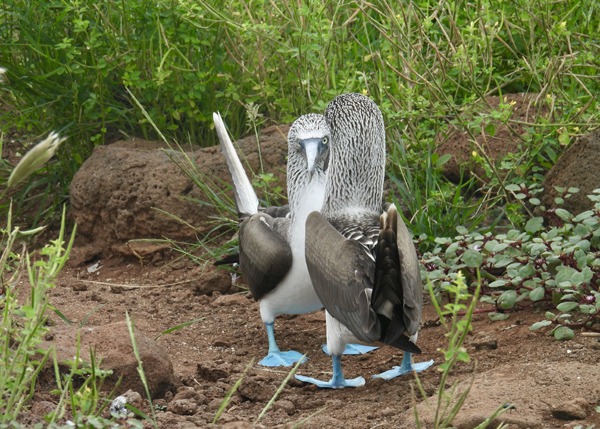
The most famous feet in the Galápagos are a brilliant shade of turquoise and doing a high-stepping mating dance on a hot, dry morning in Ecuador.
A male Blue-footed Booby slowly lifts one webbed beauty at a time, graciously extends his wings, bows his beautiful head, arches his neck and whistles. The object of his affection seems. She’s starting to mirror his movements instead of walking away.
Me and the other looky-loos gathered a respectful distance away are pretty giddy, though. We’ve come from around the world — past thousands of boobies splashed on socks and adventure travel hats and reusable water bottles — for this moment. We don’t even need zoom lenses to see the real-life version of this almost clown-like seabird with old soul eyes.
Standing here slack-jawed makes me think of our welcome briefing aboard the National Geographic Endeavour II with National Geographic-Lindblad Expeditions.
“If it’s your first time here in the Galápagos, well, let me tell you that what you read in the magazines, and what you have seen in all the documentaries, nothing will get you ready for this unbelievable week,” naturalist guide Celso Montalvo predicted. “It will be very difficult to explain the feeling that you get to see with not just your eyes but also experience with your heart.”
My heart is wide open as I set sail, hoping to see as many of the “Galápagos Big 15” as possible during seven nights at sea that start on Baltra Island end on San Cristóbal Island.
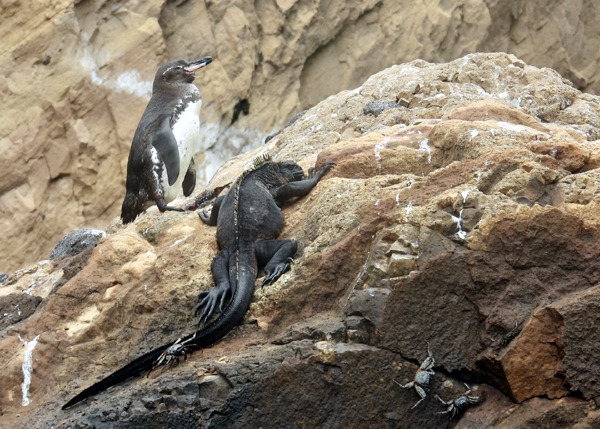
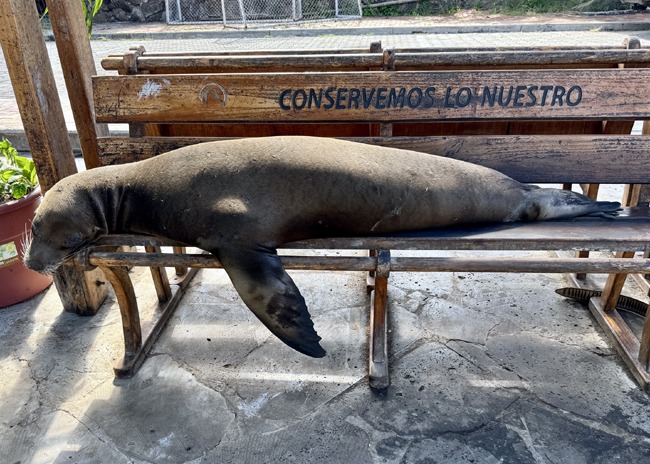
The list varies slightly depending on who’s making it, but it goes something like this: Blue-footed Boobies, Red-footed Boobies, Galápagos giant tortoises, marine iguanas, land iguanas, Great and Magnificent Frigatebirds, Sally lightfoot crabs, Flightless Cormorants, Galápagos Penguins, Galápagos sea lions, Galápagos fur seals, green sea turtles, Waved Albatross, Galápagos Hawks and American Flamingos.
Spoiler alert: I see all but the albatross plus the Nazca Booby, baby frigatebirds, ghost crabs, mating locusts and so much more. But if you want to be precise about it, I don’t see all three species of land iguanas and I’m itching to go back for “Christmas iguanas,” which are the marine iguanas of Española Island that turn red and green during breeding season.
You’ll find the Galápagos Islands 1,000 kilometres off the west coast of Ecuador on the equatorial line in the Pacific Ocean. This volcanic archipelago boasts 19 main islands, four of which are inhabited by 33,000 people. I’ll visit eight islands on my “Exploring Galápagos” cruise.
“Every day is going to be different,” promises expedition leader Paula Tagle. “I don’t want to say that it’s going to be better because each island is unique. The geography, the animals, the species — everything is unique wherever we go.”
As Montalvo chimes in: “We wake up and there’s another island. The purpose is to visit this impressive wildlife that have no fear. It’s an isolated place that we do the best as humans to protect it.”
I see those adorable boobies on day two on North Seymour Island, where I practically trip over land iguanas, watch tiny lava lizards doing push-ups to signal how tough they are, and spot both kinds of frigatebirds resting in the trees. It’s the first time I’ve seen males inflate their enormous red neck pouches to attract females.
Love is definitely in the air this week.
The neat thing about the Galápagos is that it’s a year-round destination. Loosely speaking, December to June is the wet season and warmer, while July to November is the cooler dry season. You really can’t go wrong, but there are nuances depending on what you hope to see and do, mindful that not every species is on every island.
My April visit winds up being warm, dry, not too windy and darn near perfect. I’m used to Canadian Arctic cruises where you’re exhilarated to see a couple of polar bears in the distance. Here you practically trip over the wildlife at every stop and can sometimes capture several species in a single photograph.
During daily lectures and cocktail hour recaps on the ship, I learn how Galápagos National Park protects one of the planet’s most unique ecosystems.
Ninety-seven per cent of this precious land is protected and three per cent is set aside for people. There are 70-odd approved visitor sites and most have short designated walking trails. You must stay 1.8 metres from the wildlife and can’t take food or drones to any of the islands. The park gives cruise ships and tour boats time slots to arrive and leave each site.
I learn how British naturalist Charles Darwin’s ground-breaking 1859 book On The Origin of Species, and his theory of evolution by natural selection, were informed by his 5-1/2 weeks here in 1835. I hear how Lindblad (now rebranded as National Geographic-Lindblad) brought the first “citizen explorers” here in 1967 and paid the salaries of the first two national park rangers.
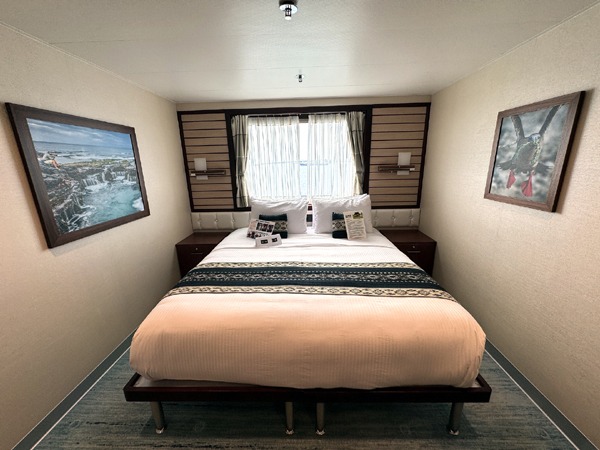
Now 300,000 people come each year on bucket-list trips. Some stay on land and do day cruises to save money or avoid seasickness. Most fly in from Quito or Guayaquil — spending a night in the cities on either end of the trip — for small-ship expedition cruises that are capped at 100 passengers to protect the fragile environment. The Endeavour’s 52 cabins can hold 96 passengers, but Lindblad sails three other ships (smaller or fancier) here.
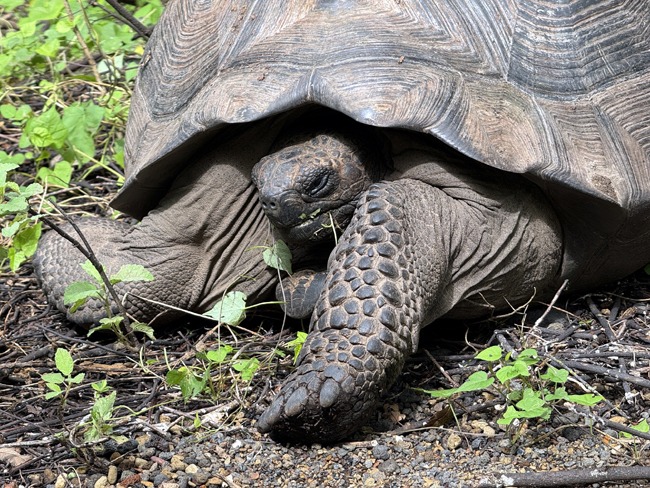
I geek out on knowing all this, just like I want to learn about iconic giant tortoises and not just look at them.
On the day that I visit Isabela Island to see the wild tortoises, we’re not allowed to step off the designated trail. So when we hear the rhythmic grunting of mating tortoises somewhere in the bush, we understand why naturalist guide Tanya Helmig urges us to “just imagine it.”
We don’t have to imagine two other solo tortoises that block our path. We wait patiently for one to pass and we carefully, and quickly, walk around another who refuses to budge.
Tortoises, by the way, are terrestrial herbivores and shouldn’t be confused with turtles that are aquatic omnivores. Early explorers used the old Spanish world galapagos (saddle) for these tortoises due to the shape of their shells, so that’s how this archipelago got its name.
I dig in even deeper on Santa Cruz Island visiting the Fausto Llerena Breeding Center to see the taxidermied remains of a beloved tortoise named Lonesome George, and Rancho El Manzanillo, a nature preserve along the tortoise migration path that serves you a buffet lunch and loans you rubber boats to go explore the grounds.
When I reminisce about what wildlife (beyond the boobies) made the biggest impression on this nature-filled journey, it’s a tie between the Sally lightfoot crabs and marine iguanas.
The brightly coloured crabs are special because they’re the first and last things I see. Rumoured to have been named for a Caribbean dancer, these coastal scavengers with intense red and blue shells are everywhere we go and a delight to photograph from every angle.
What came first, marine iguanas or the Godzilla franchise?
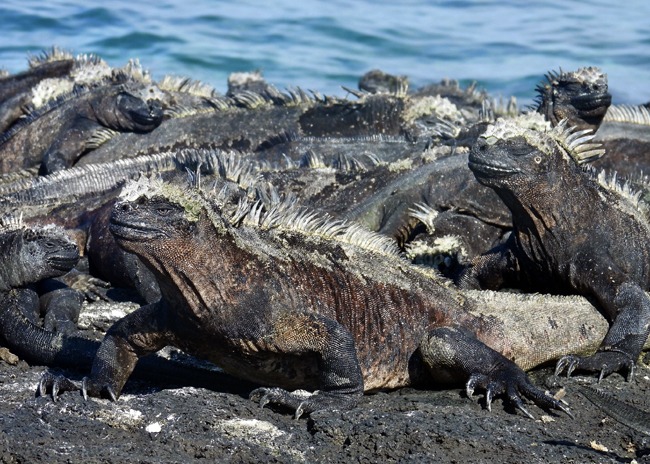
Dark and stocky, with blunt snouts, sharp teeth, long claws and dorsal crests of spiky scales, marine iguanas are the world’s only sea-going lizard. I see heaps of them basking in the sun gathering energy to hunt for algae, but I’m going to have to return to try again to see them swimming and diving.
The beauty of the Galápagos is that you get to create your own perfect trip.
You can be active snorkelling, kayaking and hiking, or take it easy on Zodiac and glass-bottomed boat outings. There are optional lectures, including photography sessions, and Lindblad’s famous open bridge so you can chat with the captain. I use town time — we go to two — to hunt for urban wildlife while others shop. And I add to the sighting sheets posted on the bulletin board to keep track of all the reptiles, birds, invertebrates, mammals and fish that we see.
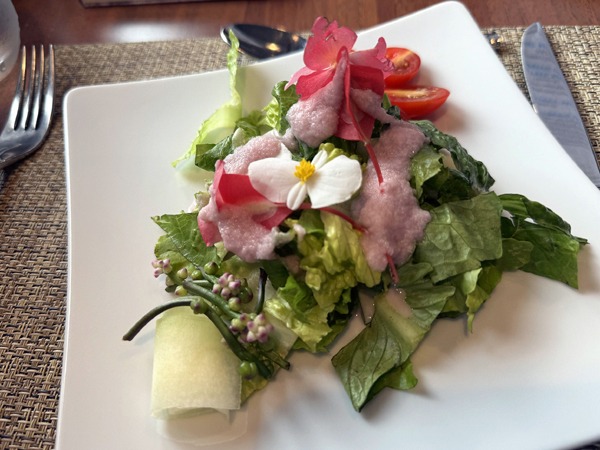
Whatever you do, pay attention when the ship’s mostly local crew proudly shares favourite foods. Look for Ecuadorian dishes like pan de yuca, a cassava cheese bread, and tigrillo, green plantains and scrambled eggs, mixed into the breakfast options, and enjoy the Galapagueñian lunch showcasing truly local ingredients.
But leave it to our fearless expedition leader to relay the best advice for exploring Galápagos. “It’s not about getting somewhere,” Tagle reminds us. “It’s about enjoying every moment.”


