

Africa
Safari Cruising for Animals
Article and photography by Lisa TE Sonne
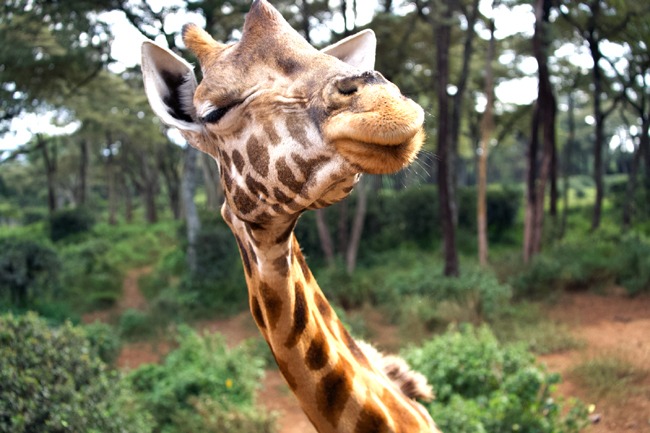
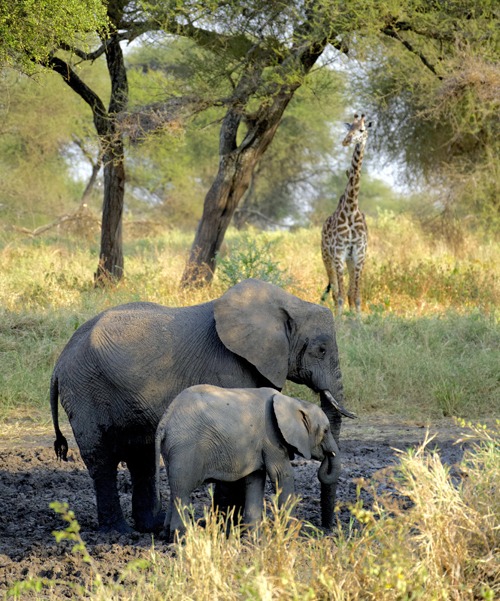
A baby elephant’s trunk reached out and touched the front of my extended camera lens as if it were my trunk. The very long tongue of a Rothschild’s Giraffe grabbed food pellets from my palm as I stood on a balcony. My husband and I had been in Nairobi, Kenya less than 24 hours, and we had already interacted with elephants at Sheldrick’s Elephant Orphanage, the first of its kind in Africa to rescue elephants. We had also hand-fed the very tall residents of the Giraffe Centre, a conservation and education site for Rothchild giraffes, a threatened subspecies.
During this unforgettable first day of our trip, we spent hours on a safari in the world’s only national park inside the capital of a country. In the 117-square-kilometer park, we looked one way and saw the highrises of the city horizon. In the other direction were seemingly endless grasslands.
Our guide, Jimmy, reminded us that a national park is not a zoo, and there was no guarantee we would see any specific animals. Our driver, Theo, advised us that, for our own safety, we were not allowed out of the vehicle.
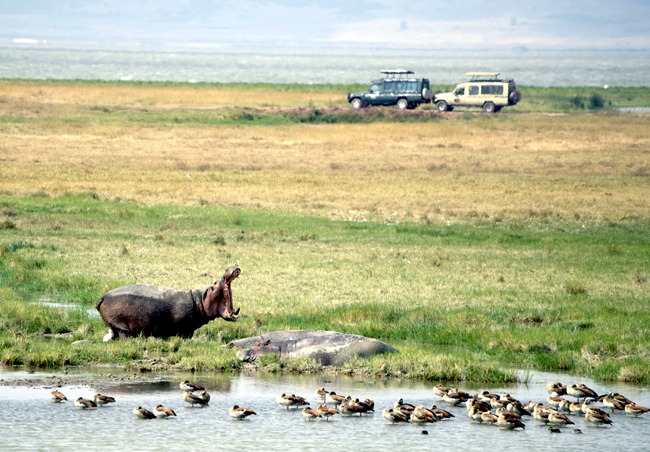
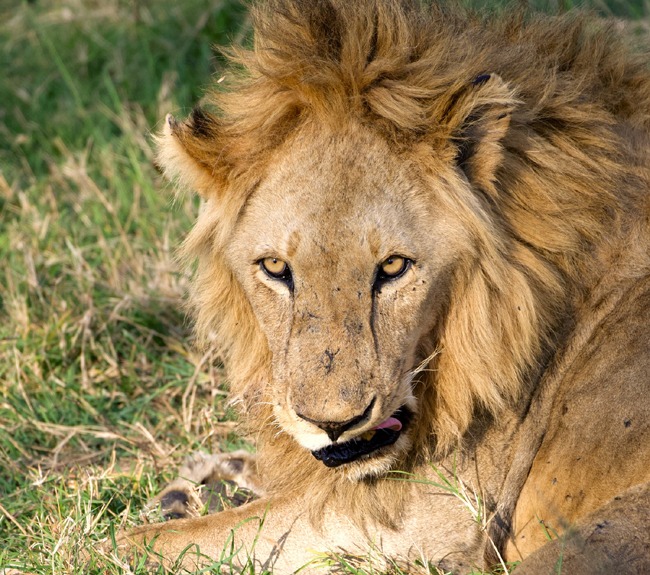
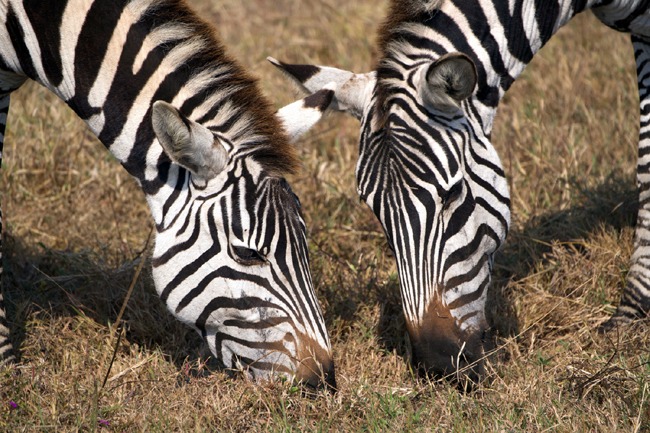
Nevertheless, in the course of our searching, we saw wild elephants and Masai giraffes roaming freely. We watched what looked like large, smooth boulders in a water hole transform into hippos as we drove closer. We learned that the pink of the male ostriches meant they were in heat and competing for the attention of the plainer females. We also spotted zebras, Cape Buffalo, baboons, lions, and bright colored birds foreign to North America.
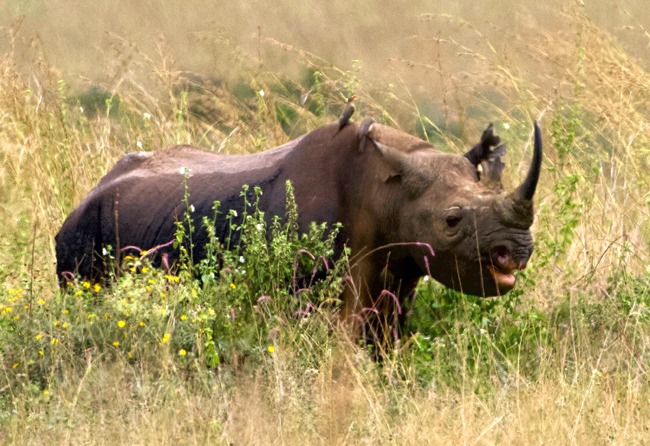
With binoculars, we could see that the specks on the hillside were endangered rhinos that use the park as a sanctuary. We could make out the iconic horns so desirable to poachers, and we could see the birds that land on top of rhinos to eat the insects on their hides.
Amazing, awesome, incredible — in only one day. Already the long flights and planning felt worth the effort. Our big bucket-list trip had started fantastically, and we were primed to board a prop plane for adventures ahead in the vast wilderness of the neighboring country of Tanzania.
Safari means “journey” in Swahili, the language spoken widely in Tanzania and Kenya, and there are many ways to journey in Africa, from more affordable group trips and camel forays, to helicopter and hot air balloon fly-overs.
Of the many expert teams who plan such trips, we handed our “wish list” for this once-in-a-lifetime adventure to Alan Feldstein, founder of Infinite Safari, who has decades of experience and knows many of the Maasai, the largest tribal group in this part of Africa. They are a semi-nomadic people who still practice many dance, jumping, beading, and initiation traditions, and they herd domesticated animals for sustenance instead of killing the wild animals.
In Tanzania, we were fortunate to have the funny and well-informed Clement, or GP (Ground Pilot), as our guide and driver, with a vehicle just for us. We started our quest in the south, at the lovely River Tree Lodge, a converted coffee farm on a river with gardens, a pool, and scampering monkeys in the trees.
We spent the next seven nights sleeping in tents, but as a previous traveler quipped, they were really “Tintos” – Tents in Name Only. On raised platforms, the large tents had mosquito-netted beds, lovely décor, full bathrooms, electricity, and amenities. Guards were posted at night to protect us from wild animals, and we were just an escorted-walk away from a lodge where we could gather with other “campers” for wonderful meals and sundowner stories around a campfire.
The people who staffed all the camps made us feel very jambo (Swahili for “welcome”). We didn’t experience any of the discomforts or inconveniences sometimes associated with camping. We did experience the sensual joys of being away from city life – the fresh air, and the smells and sounds of being in the beguiling nature of Africa.
Our first night in a tent was the night before my birthday. We slept at the Tarangire Ndovo Camp in the middle of the Tarangire National Park. The thick tent canvas was all that separated us from the nightlife of wild animals.
Just after midnight, I was awoken by some crashing noises along the side of our tent. I shook my husband awake as we heard the noises round the corner to the front of the tent. We gingerly unzipped a small portion of the front flap, adjusted our eyes to the dark, and saw a large, well-tusked male elephant, a female, and an endearing-looking baby.
Elephants are so massive that they spend 20 of every 24 hours looking for food and eating, and that’s what this family was doing. The huge male was bundling up branches and grasses in his trunk and pounding them against the ground to shake off insects. All this was about twelve feet in front of our wooden front porch. We peeked out, respectfully, but in full wonder. My impulse was to get closer, but my husband wisely prompted us to stay in the tent. As cute as the baby looked, this was not Dumbo in a Disney animated film, but it was a better start to my birthday than any movie would have been!
Our next base was at a higher elevation in the Lemala Ngorongoro Tented Camp on the rim of the multimillion year old Ngorongoro Crater in an engaging acacia forest. In front of our tent porch with rocking chairs, elephants visited us before breakfast. After eating, we drove down onto the floor of the crater and into a lively ecosystem of wildlife that includes “the Big Five,” the toughest and most dangerous creatures for the big game hunters of old to hunt on foot: the black rhino, the African elephant, the Cape buffalo, the lion, and the leopard. Now visitor experiences are designed to protect the animals—any shooting is for photos and videos, not heads, hides and horns.
We had seen four out of “the Big Five”– all but the leopard – and that elusive feline kept thwarting us. Often we thought we had spotted one lounging in a tree in the distance that, when we were disappointed at closer range, we started calling them “Leopard trees.”
On the dusk of our second day exploring the crater floor, as we were heading back after a long, thrilling day of watching animals, I pointed to a moving shadow in a bush and asked, “What’s that?”
“Leopard!” GP shouted. He immediately maneuvered the vehicle and stopped where we weren’t too close, but could best capture the leopard’s image and appreciate its sleek, spotted beauty.
As we traveled further into the Serengeti, the Nasikia Naona Moru camp and the Nasikia Mobile Camp Northern Serengeti were both wonderful places to stay and to enjoy the long safari days on open roads. We had asked our guide to avoid the crowd clusters of other tourist vehicles that sometimes rushed to radioed wildlife sightings. We savored being able to stop with no vehicles in sight to watch zebras roll around in the dirt or a pride of drowsy lions lounge after a big meal. We spent an hour watching an elephant herd bathe using their trunks as snorkels, apply red dirt on their bodies as sunscreen and insect repellent, and rub against trees as a scratching post.
We experienced both a soothing solitude and a deep feeling of abiding connectedness that arise from being far from normal life, but surrounded by a species so likable and so different.
We hoped to witness part of the Great Migration of hundreds of thousands of wildebeests and zebras who forge the Mara River twice a year, going from Kenya to Tanzania and back, seeking food and risking death by either a crocodile in the river or by a lion or other predator in the grasslands. It is considered one of the largest animal migrations on the planet, and the last remaining area of mass land migrations in Africa.
We had seen large groups of wildebeest all through our trip heading toward the Mara River. As we reached their staging grounds on the banks and cliffs of the river, where the animals gathered to decide if it was safe to cross, we sometimes felt so crowded with vehicles that it seemed like it was the human species that was on a great migration.
After all our good luck on the trip and our hours of vigilance for the Mara River crossing, we were having a bush lunch in the shade when the radio call came that the wildebeest were crossing the Mara. By the time we arrived, we were jockeying for position from the third row of vehicles, but at last got a partial view of the spectacular event.
When the other vehicles moved on, hoping for better views elsewhere, we stayed and witnessed the most brutal part of “the circle of life” — a “kill.” On the far bank, where we had seen hundreds of wildebeest push up out of the water and onward uphill, our cameras captured the distant raw brutality of a wildebeest in the grip of a crocodile’s jaw as it thrashed the whole creature up and pounded it down on the water.
When it was over, I was glad we had also witnessed the other parts of life’s cycles. We saw baby zebras and elephants being nursed by their moms, monkeys grooming each other, adorable jackal pups peeking out of their hole as they waited for a parent to bring food back, and birds showing off their availability for mating.
Safari cruising for animals is unlike any other road trip.
The unique journey left me with a profound sense of asante sana – Swahili for “thank you very much” – and a resonating pulse that I was glad to be alive.


