

Cruise
Le boat: Family Adventure in the South of France
Article and photography by Jennifer Merrick
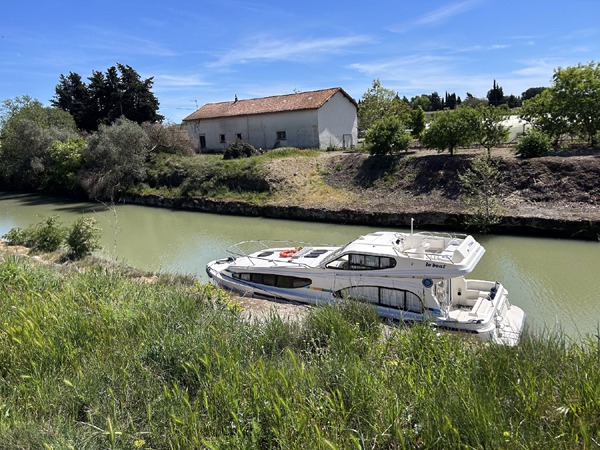
“Two more curves and a bridge and we’re there,” the navigator (our daughter) tells the captain (her brother), who’s piloting a houseboat down the Canal du Midi in southern France. Mom and Dad sit behind them, taking in the bucolic scenery. Row after row of grapevines that stretch out to the Pyrenees mountains, which appear almost as a mirage on the horizon.
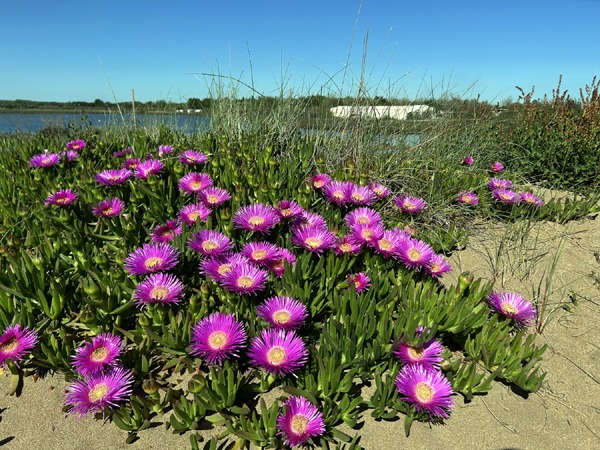
Spring is in full bloom here in April, unlike the winter that’s hanging on back home, and we spot fragrant lilacs, red poppies and clusters of pink and purple flowers along the waterway.
This is our family’s third time on Le Boat, a French houseboat company with over 30 bases and a fleet of 900+ boats, ranging from approximately 30 to 50 feet, operating throughout Europe and in Ontario, Canada.
No boating experience or license is required to operate them, and we had no nautical background at all when we first tried out a houseboat on the Rideau Canal five years ago. Even with the instruction provided, there was a learning curve to handling the ropes, navigating the locks, steering the sizable boat and living in close quarters. But we soon had our canal legs and enjoyed it so much we booked another Le Boat vacation on the Nivernais Canal in central France. In the Burgundy region, we not only relished the relaxed pleasure of boating we had in Ontario but experienced a whole new culture in an authentic rather than touristy way.
Three years later, we’re back in the ‘Land of Wine and Cheese’ with Le Boat to explore the Canal du Midi in the south. Built between 1666 and 1681, the waterway connects the Atlantic Ocean to the Mediterranean Sea, forming one of Europe’s oldest and most remarkable navigable waterways. Now a UNESCO World Heritage Site, it’s celebrated for its ingenious engineering and flora and fauna along its banks.
One of the reasons we love our Le Boat family adventures so much is the freedom to travel at your own pace and make your own schedule. This is particularly true on the Canal du Midi, where with a few exceptions, we could berth wherever we fancied along the waterway, whether it was for a stop for a croissant and coffee or a quiet place in nature to spend the night.
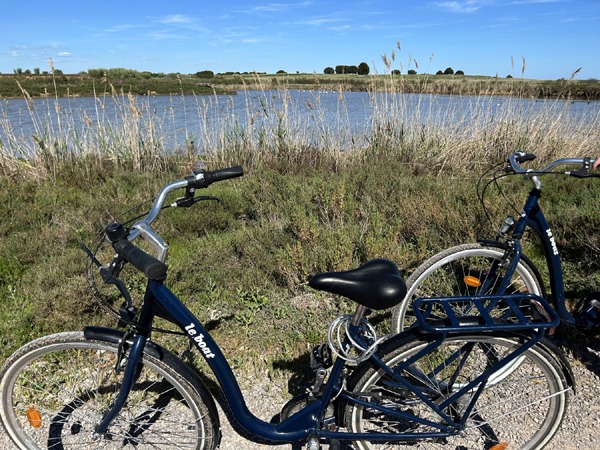
Adding to our sense of freedom were the bicycles on board. A bike path runs the length of the canal, so we could pedal into any town we passed to explore or pick up groceries. Food shopping is a treat in France, where freshly baked bread and pastries, well-priced delicious cheeses, local wines and seasonal produce abound. The combination of biking and boating, spontaneous adventures and relaxation, historic towns and verdant countryside, the beauty of nature and the marvels of engineering turned our trip into one of our most memorable family vacations ever. Here were just a few of our favorite moments:
Flamingos in Marseillan
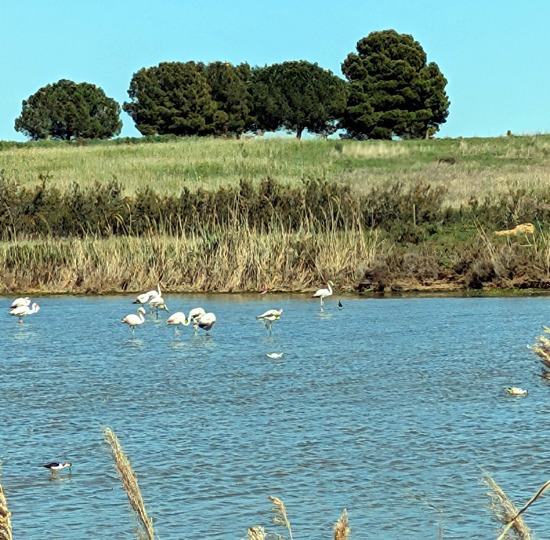
Marseillan is the eastern terminus of the 150-mile Canal du Midi and we were looking forward to enjoying fresh seafood in this coastal town famous for its mussels and oysters. What we didn’t expect was the remarkable wildlife. Just beyond the harbor lie salt marshes and the Étang de Thau, a coastal lagoon, with a boardwalk that weaves through the wetlands. As we were biking, we spotted herons and egrets, and more surprisingly, a flock of flamingos. I had always associated these striking birds with more tropical climates and hadn’t realized they were native to this beautiful region in southern France.
Engineering Marvels
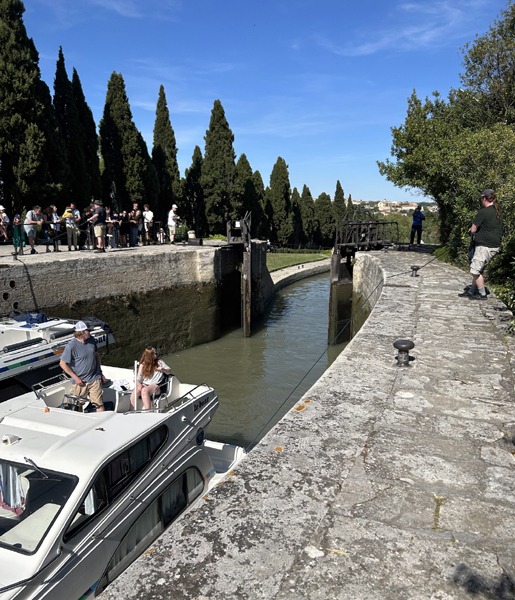
Almost as captivating as the wildlife were the engineering marvels of the canal itself. It boggled our minds that these were built at a time when there was no electricity, modern machinery or engines. Locks, which function as watery elevators that raise and lower boats between different levels, are remarkable on their own, but the Fonseranes Locks are at a whole other level. Eight levels to be exact. Spanning almost 3280 feet, this ‘staircase’ of oval lock chambers allowed us to rise 71 feet in 45 minutes over 980 feet. This ingenious series of basins and gates is one of the biggest tourist attractions of the area, and holidaymakers gather along the sides to watch boats like ours navigate it. Though it was a little disconcerting having an audience, it was thrilling to lead the boat through this ingenious lock system.
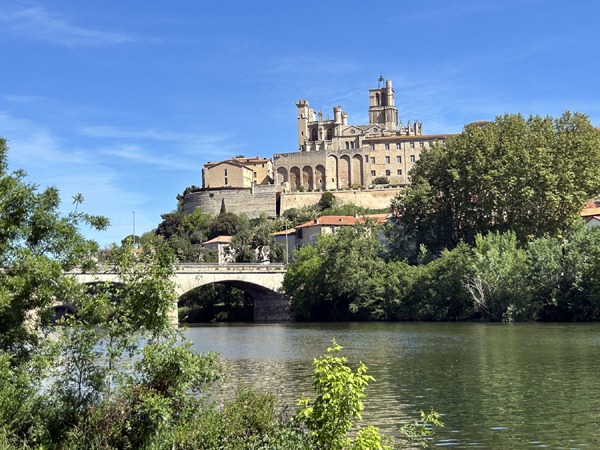
Another very cool engineering moment was floating on top of a viaduct with the river below us, just before we reached the Fonseranes Locks. It felt surreal to be on a bridge going through a medieval town, on the same level of cars and pedestrian bridges, with its grand architecture in the background. Who knew it was possible to have a bird’s-eye view from a boat? Later on our trip, we sounded our horn before going through the ‘Vault of Malpas’, a 165-meter-long tunnel through a brittle honeycomb like sandstone, which was Europe’s first navigable tunnel and showcases the genius of the canal’s architect, Pierre-Paul Riquet.
Exploring Beziers by bike
After admiring Beziers from the water, we knew we wanted to see more of this town steeped in history going back to Roman times. And so the next morning, we hopped on our bikes and pedaled into the city. The bike path took us across bridges right into the city centre, where we explored the Saint-Nazaire Cathedral, whose origins date back to the 8th century. Like all great cathedrals, its arched Gothic architecture, luminous stained-glass windows, intricate woodwork and grand pipe organ inspired a sense of awe and majesty. We then strolled the city squares and streets, admiring sculptures and murals and its buildings with honey-coloured limestone and terracotta-tiled roofs before stopping for lunch at a North African restaurant. Given southern France’s ties to Algeria, Morocco, and Tunisia and its proximity to the Mediterranean, it was no wonder the food was so tasty.
Browsing in Le Somail
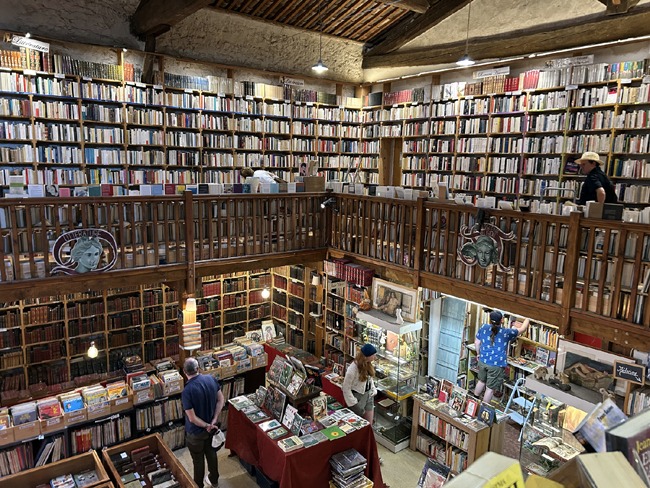
There are more books than people in the small village of Le Somail, and you can find them all at Le Trouve Tout du Livre bookstore. A 17th-century house overflows with over 50,000 books from a children’s collection to classical and contemporary literature and everything in between. Our captain bought a 1950s French cookbook and vowed to try some of the recipes back home (we’re still waiting). Also fun to browse was the floating grocery barge, where we stepped on board to pick up baguettes, cheeses and local goodies.
Impromptu wine tasting at Caveau Port Guery
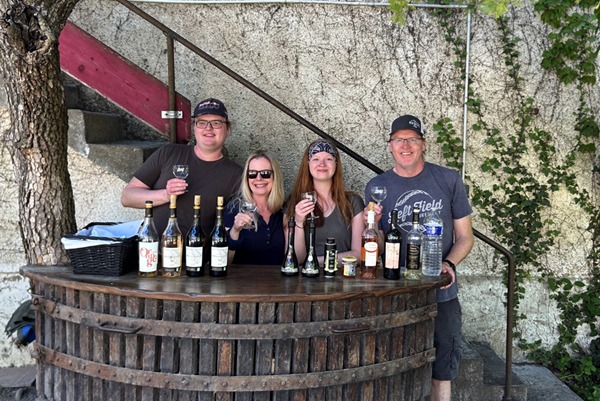
It was a sign that we had to stop. The placard read ‘Degustation Gratuite’ (free tasting). Should we check it out? Pourquoi pas? We quickly moored the boat and followed a path that led past vineyards and down to a treed garden dotted with wine barrels and stone structures. A friendly dog greeted us, and a few minutes later, its equally affable owner welcomed us to his family’s vineyard. He served up generous tastings of not only his organic wines, but those of his uncle’s ‘just down the road’. It turned out that his family has been growing grapes and making wine since the 18th century. He joined in the sampling and by the time we left, we had fallen in love with the wines, the dog and the estate.
This spontaneous stop was one of the favourite moments for our captain and navigator, who at the end of the trip asked where’s our next Le Boat trip going to be?


