

-

- Leon Catherdral
Spain
The Camino de Santiago, from Burgos to Finisterre
Article and photography by Nicholas Kontis
The Camino de Santiago, which stretches more than 800 kilometers across northern Spain from the Pyrenees Mountains to the northwestern tip of the Iberian Peninsula, is one of the most famous trails on earth. Known the world over as a Roman Catholic pilgrimage route, it is a route where modern adventurers come in search of redemption, spiritual or historical discovery, rustic food and wine, or simply healing and transformation.
There are many ways to travel the Camino — from Madrid or Sevilla, through Portugal, or even from England after a passage by boat. Each of them finishes in Santiago de Compostella. Each offers a rich and rewarding tapestry of landscapes, architecture, spiritual encounters, and local traditions. In every pilgrim’s Camino, there is a moment when the noise of the outside world falls away, and the rhythm of footsteps becomes a kind of prayer.
This story explores a few of the towns that one might encounter along the Camino Frances, The French Way, the most popular route followed by 70 percent of walkers.
Starting Out
Burgos is not only a convenient starting point but a profound one. Its Gothic Cathedral, a UNESCO World Heritage Site, towers over the city and the Camino itself. Dedicated to the Virgin Mary, it is also the burial place of El Cid, Spain’s legendary 11th-century military hero. Pilgrims often take time here to reflect before setting out, lighting a candle in the silent nave for the long road ahead.
Leaving Burgos, the route cuts westward into the heart of the Meseta, Spain’s central plateau. This stretch is often seen as a psychological challenge — flat, repetitive and exposed to sun or wind — but also a place of inner stillness and personal growth.
One of the first remarkable towns along this stretch is Castrojeriz, a sleepy village that rises upon a hilltop, the ruins of a medieval castle crowning its ridge. The town unfolds gently along the Camino path, its Roman and medieval roots still visible in old churches and stone facades. The view from the castle, especially at sunrise, is hauntingly beautiful: a sea of golden plains rolling in every direction.
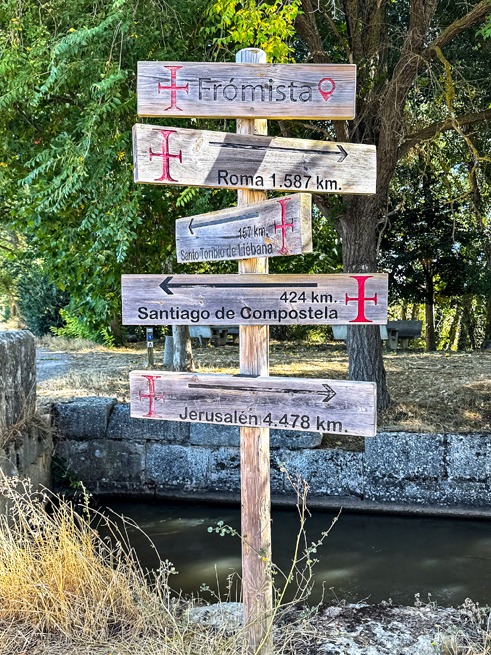
Approaching Frómista, pilgrims cross the historic Canal de Castilla, a marvel of 18th-century engineering. Once a vital artery for transporting grain and goods, the canal is now a peaceful companion for a few kilometers. Walking beside its gentle waters under poplar trees offers a rare contrast to the arid lands nearby. The locks near Frómista are particularly impressive, often drawing the attention of photographers and contemplative pilgrims alike.
Across the Meseta
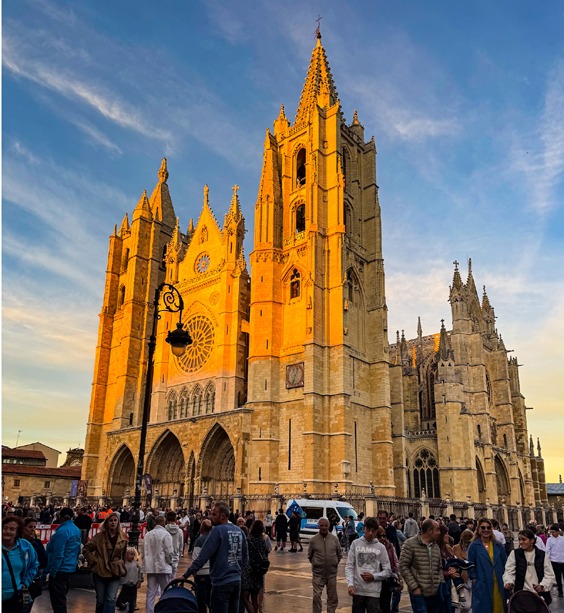
After days of solitude on the Meseta, entering León feels like a homecoming. This vibrant city, where old meets new, is a major stop on the Camino, known for its hospitality and spiritual offerings. The Cathedral of León, with its ethereal stained-glass windows, is a jewel of Gothic architecture. Nearby, the Convent of San Marcos, now a luxury parador, once housed pilgrims and lepers. León also recharges the modern pilgrim in more earthly ways — with lively tapas bars, artisan shops and street musicians. It’s a city where the Camino’s medieval past and modern life blend seamlessly.
Continuing westward, the route ascends gradually toward the mountains. The city of Astorga sits at the crossroads of the Camino Frances and the Via de la Plata. Here, pilgrims marvel at the Episcopal Palace, designed by Antoni Gaudí — one of only a few buildings Gaudi created outside Catalonia. Nearby, the Cathedral of Astorga dazzles with its baroque façade and serene cloister. Many pilgrims also indulge in maragato stew, a hearty, reverse-course meal perfect for fueling up for the climb ahead.
Ponferrada’s a name was derived from the iron bridge that once guided pilgrims across the river. The star attraction here is the Castillo de los Templarios, a fortress that once belonged to the Knights Templar. Its walls hold centuries of secrets, offering stunning views and a tangible link to the legends that swirl around the Camino.
Nearby, the Prada a Tope Winery in Cacabelos welcomes pilgrims with wine and traditional Bierzo hospitality. Known for its commitment to organic farming and heritage preservation, it’s a perfect stop to savor Mencía reds and local chestnut liqueurs.
Green Galicia
The climb to O Cebreiro, through the green hills of Galicia, is one of the most challenging — and rewarding — sections of the Camino. As you ascend through misty forests and past wild horses, the landscape shifts dramatically. This tiny mountain village, perched at 1,300 meters, feels otherworldly. With its pre-Roman pallozas (stone dwellings) and the Iglesia de Santa María Real, O Cebreiro radiates Celtic energy.
Here, the legend of the Holy Grail intertwines with the Camino. It’s said that a miracle occurred during a mass when the Eucharist turned into real flesh and blood—an event recognized by the Vatican.
After the descent into Galicia’s lush valleys, the route can detour through Samos, home to one of Spain’s oldest and most influential monasteries. The Monasterio de San Xulián de Samos has offered refuge to pilgrims since the 6th century. Its cloisters, adorned with peaceful fountains and ancient frescoes, create a timeless atmosphere that calms the weary soul.
As the Camino crosses the Miño River, pilgrims arrive in Portomarín, a town with a remarkable story. In the 1960s, the original village was submerged as a reservoir was constructed. Stone by stone, key monuments—including the imposing Church of San Nicolás—were relocated to higher ground. On misty mornings, the old Roman bridge’s remains still appear ghostlike under the water’s surface.
The trail now winds through Palas de Rei and Arzúa, quintessential Galician towns where eucalyptus trees line the path and cows often outnumber people. In Arzúa, famous for its creamy tetilla cheese, pilgrims begin to sense the proximity of Santiago. The trail becomes busier as more pilgrims join from other routes, including the Camino Primitivo and Camino del Norte. The energy builds, and excitement is palpable with each step.
Santiago de Compostela: The Goal
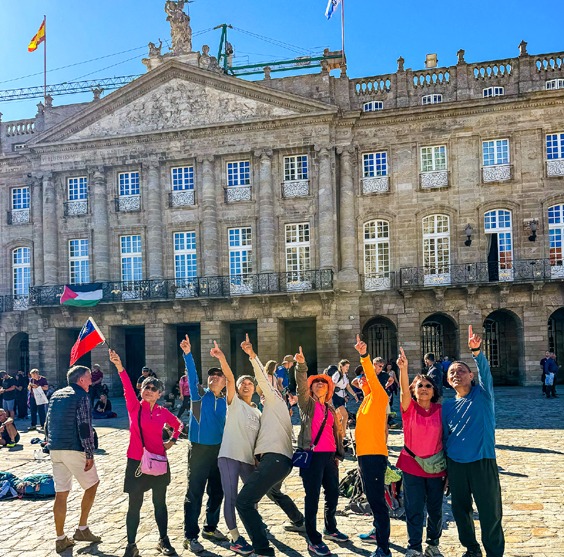
Finally, the towers of the Cathedral of Santiago de Compostela pierce the sky. Pilgrims often weep upon entering the Praza do Obradoiro, overwhelmed by joy, relief and the gravity of their arduous journey. Inside the cathedral, they hug the statue of St. James, offer prayers, and attend the Pilgrim’s Mass, often highlighted by the dramatic swinging of the Botafumeiro incense burner.
For some, the journey doesn’t end here. A growing number of pilgrims continue to Finisterre, whose name means “the end of the Earth.” The road now is less busy than before, lending itself to deep reflection. Negreira is a quiet town nestled among rolling hills. Local legend in A Barca, near Dumbria, holds that the Virgin Mary arrived by stone boat to encourage St. James in his missionary work. In Carnota, pilgrims encounter a stunning Galician coast and the longest hórreo (grain storehouse) in the region, symbolic of Galician rural life. The fishing town of Muros, with its narrow granite streets and seafood cuisine, offers a final pause before the end of the route.
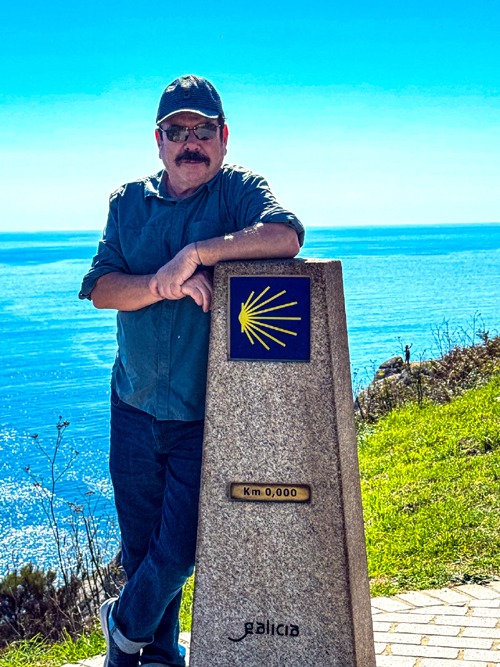
Finally, Finisterre awaits. Pilgrims burn a piece of clothing or leave a token at the lighthouse that overlooks the seemingly endless Atlantic. Even from here, some push on, north along the wild Costa da Morte, to Muxía. Here, tradition says, the Virgin appeared to St. James at the Santuario da Virxe da Barca. The jagged rocks near the church seem sculpted by nature and myth alike. This is where the sea meets the sacred — and where the most dedicated of pilgrims truly end their Camino.
‘The End of the World’
The Camino from Burgos to Muxía is more than a walk: It’s a rite of passage, a living link to centuries of spiritual seekers, soldiers, poets and wanderers. Along the Way, the land itself is the instructor: It teaches patience in the Meseta, resilience in the mountains, joy in the company of strangers, and peace in the simple act of walking.
By journey’s end, one realizes that the Camino doesn’t really finish in Santiago, or even Muxía. To many pilgrims, the Camino walk is not complete without a visit to Kilometer Zero at Finisterre. This community is celebrated as the landing site of the boat that carried St. James’ body to the coast of Spain. According to legend, a local pagan queen refused to allow his burial there, decreeing that he could not be buried within a three-day walk from the coast. As a result, his remains were carried inland, where he was laid to rest beneath the “field of stars,” the location of the Cathedral of Santiago de Compostela.
The Camino changes a person, fostering new friendships with fellow pilgrims and deeper connections with the earth itself. And the transformation continues long after the final steps of this spiritual odyssey are taken. Those who undertake the Camino find their hearts are lighter, their spirits stronger.


